
Claude Code vs Traditional Coding: Why AI-Assisted Development Wins
The software development landscape has shifted. AI-assisted coding tools like Claude Code aren't just autocomplete on steroids — they're fundamentally changing how software gets built. But does AI-assisted development actually produce better results? And when should you still code the traditional way?
This article provides an honest comparison between Claude Code and traditional coding across the dimensions that matter most: speed, quality, learning curve, maintainability, and real-world applicability.
What Makes Claude Code Different
Before comparing, let's clarify what Claude Code actually is. It's not a chatbot that gives you code snippets. It's an agentic coding tool that:
- Reads your entire project structure and understands context
- Writes complete, runnable code across multiple files
- Executes code and iterates on errors automatically
- Refactors existing codebases based on natural language instructions
- Handles everything from simple scripts to complex architectures
It operates directly in your terminal, working alongside your existing tools and workflows. Think of it as a highly capable junior developer who never gets tired, works at superhuman speed, and has read every programming tutorial ever written.
Speed Comparison
Traditional Coding
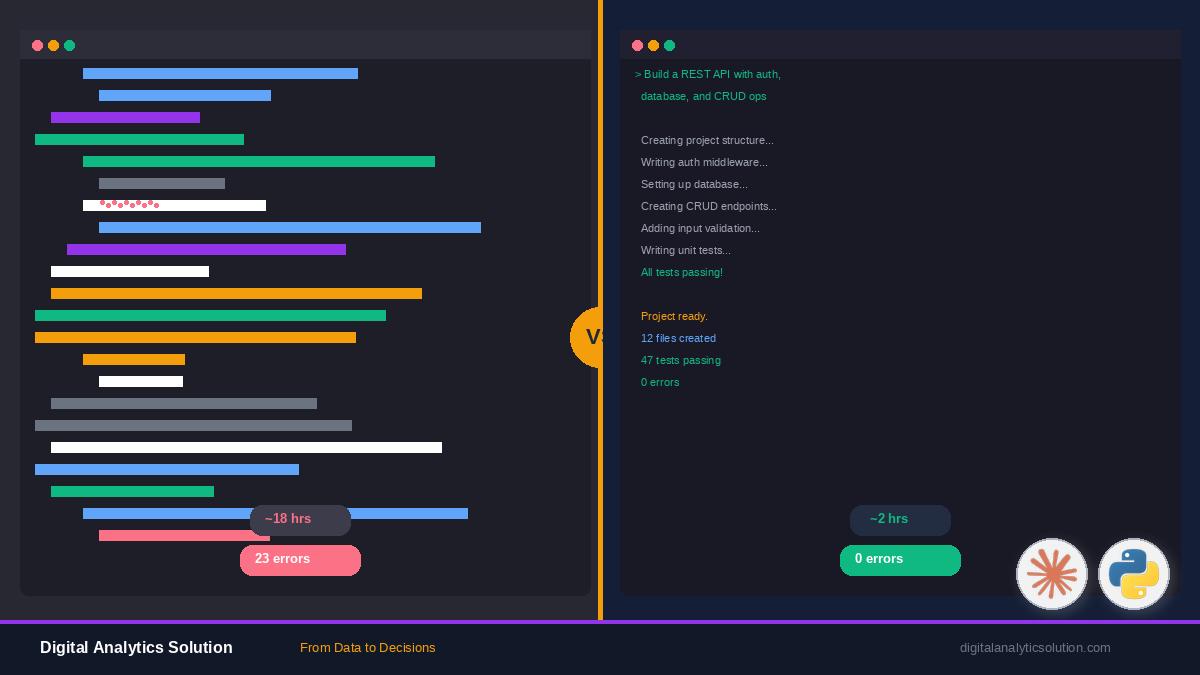
Building a REST API with authentication, database integration, and CRUD operations:
- Setup and boilerplate: 1-2 hours
- Core implementation: 4-8 hours
- Testing: 2-4 hours
- Bug fixing and refinement: 2-4 hours
- Total: 9-18 hours
Claude Code
The same REST API:
- Describing requirements: 5-10 minutes
- Initial generation: 5-15 minutes
- Review and iteration: 30-60 minutes
- Testing and refinement: 30-60 minutes
- Total: 1-2.5 hours
That's a 5-10x speed improvement for standard development tasks. The gap is even wider for boilerplate-heavy work like CRUD interfaces, form validation, and data processing scripts.
But speed isn't everything. Let's look at other dimensions.
Code Quality
Where Claude Code Excels
Consistency: Claude Code follows best practices uniformly. It doesn't have bad days, doesn't get sloppy at 11 PM, and doesn't cut corners when tired.
Error handling: It tends to include comprehensive error handling by default — try-catch blocks, input validation, meaningful error messages — that developers often skip when moving fast.
Documentation: Ask Claude Code to add comments and documentation, and it produces clear, consistent docs throughout.
Modern patterns: It's trained on current best practices, so it naturally uses modern syntax, patterns, and conventions.
Where Traditional Coding Can Be Better
Architecture decisions: Senior engineers make better high-level architectural choices because they understand business context, team capabilities, and long-term maintenance implications.
Domain-specific optimization: A database expert writing SQL will produce more optimized queries than Claude Code's generic approach. A performance engineer will spot bottleneck patterns that AI might miss.
Unique problem solving: For truly novel problems with no precedent in training data, human creativity and intuition still lead.
Learning Curve
Traditional Coding
- Learn a programming language (3-12 months)
- Learn frameworks and libraries (1-6 months per framework)
- Learn development tools (1-3 months)
- Practice problem-solving patterns (ongoing)
- Build real projects for portfolio (ongoing)
Total time to productivity: 1-2 years for a junior developer role.
Claude Code
- Install Claude Code (5 minutes)
- Learn effective prompting (1-2 weeks)
- Understand enough to review generated code (1-3 months)
- Build real projects (start immediately)
Total time to productivity: Days to weeks for useful output, with depth growing over time.
This doesn't mean Claude Code replaces the value of deep programming knowledge. But it dramatically lowers the barrier to building functional software, which is why vibes coding has exploded in popularity.
Maintainability
Claude Code's Advantage
- Consistent code style across the entire project
- Comprehensive test coverage when requested
- Clean file structure and naming conventions
- Easy to refactor — just describe the desired changes
Potential Pitfalls
- Generated code can be verbose
- Without understanding the code, debugging becomes challenging
- AI-generated patterns might not match your team's conventions
- Over-engineering — Claude Code sometimes adds unnecessary abstraction
The Solution: Review and Understand
The best approach combines Claude Code's speed with human oversight. Generate the code quickly, then review and understand it. This is faster than writing from scratch and produces better results than accepting AI output blindly.
Real-World Scenarios
Scenario 1: Startup MVP
Winner: Claude Code
Building a minimum viable product needs speed above all else. Claude Code can produce a functional MVP in a fraction of the time, letting you validate your idea before investing in polished engineering.
Use vibes coding with Claude Code to go from idea to deployed product in days instead of months.
Scenario 2: Large-Scale Enterprise System
Winner: Traditional Coding (with AI assistance)
Complex enterprise systems require careful architecture, compliance considerations, and team coordination. Claude Code excels as an assistant here — generating boilerplate, writing tests, creating documentation — but humans should drive the architecture.
Scenario 3: Data Analysis Scripts
Winner: Claude Code
One-off data analysis tasks are perfectly suited for Claude Code. Describe the analysis, get results, iterate. No need to remember pandas syntax or matplotlib configuration.
Scenario 4: Automation Workflows
Winner: Claude Code + n8n
Combining Claude Code for custom logic with n8n for workflow orchestration creates a powerful automation stack that's faster to build and easier to maintain than traditional scripting approaches.
Scenario 5: Performance-Critical Systems
Winner: Traditional Coding
Real-time systems, game engines, and high-frequency trading systems require microsecond-level optimization. While Claude Code can write performant code, human experts with deep knowledge of hardware, memory management, and algorithmic optimization still produce superior results for these specialized domains.
The Hybrid Approach: Best of Both Worlds
The most productive developers in 2026 aren't choosing between Claude Code and traditional coding. They're combining both:
- Use Claude Code for scaffolding — project setup, boilerplate, configuration files
- Write critical logic manually — core algorithms, security-sensitive code, performance-critical paths
- Use Claude Code for testing — generate comprehensive test suites quickly
- Iterate with Claude Code — refactoring, adding features, fixing bugs
- Review everything — understand what was generated before committing
This hybrid approach delivers the speed of AI-assisted development with the quality and control of traditional engineering.
Productivity Metrics: The Numbers
Based on developer surveys and productivity studies from 2025-2026:
| Metric | Traditional | Claude Code | Hybrid |
|---|---|---|---|
| Lines of code per hour | 50-100 | 500-2000 | 300-1000 |
| Bug introduction rate | 15-25 per 1000 LOC | 10-20 per 1000 LOC | 5-15 per 1000 LOC |
| Time to first prototype | 1-4 weeks | 1-3 days | 2-5 days |
| Test coverage | 40-60% (typical) | 70-90% (when requested) | 75-95% |
| Documentation quality | Varies widely | Consistent, thorough | Consistent, thorough |
The hybrid approach consistently outperforms both pure approaches because it leverages AI speed while maintaining human quality control.
Making the Transition
If you're a traditional developer looking to adopt Claude Code, start here:
- Begin with low-stakes tasks — Scripts, utilities, test files
- Review everything — Understand the generated code before shipping
- Build your prompting skills — Be specific about requirements, constraints, and patterns
- Gradually increase scope — Move from scripts to features to full applications
- Combine with your stack — Integrate Claude Code with n8n, Google Workspace, and your existing tools
If you're new to programming entirely, explore vibes coding — it's the fastest path from zero to building functional software.
The Bottom Line
Claude Code doesn't make traditional coding obsolete. It makes it optional for many tasks. The developers who thrive in 2026 and beyond are those who can fluently operate in both modes — knowing when to let AI handle the implementation and when to take the wheel themselves.
The question isn't "Claude Code or traditional coding?" It's "How do I combine them for maximum impact?"
Ready to see all these tools working together? Read The Complete Automation Stack: n8n + Claude Code + Google Workspace.